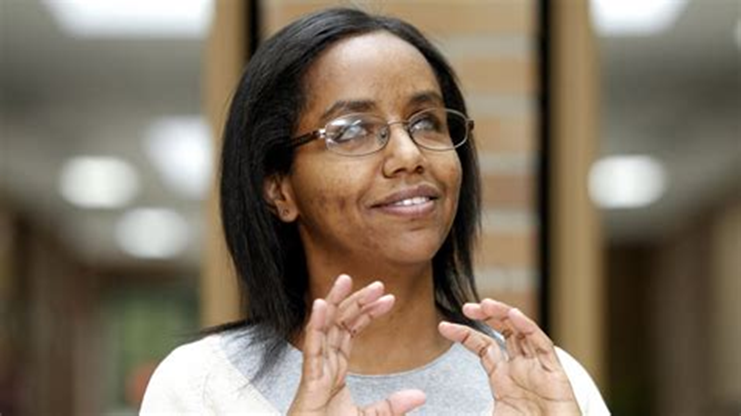
Every time I hear it, or I say to myself in my internal dialogue: «"That's very difficult, I can't do it, or it's very hard for me, it's not fair..." I think of stories of overcoming adversity that encourage me and give me the strength and confidence to keep going. Gennet Corcuera's story is one of the ones I most admire for that strength and drive.
«"Gennet Corcuera was born in Ethiopia, abandoned in an orphanage, and grew up in a double silence: she couldn't see, she couldn't hear, and no one ever called her name. Until..." Carmen Corcuera, The mother-in-law of the then Spanish ambassador to Ethiopia looked her straight in the eye and decided to call her daughter.
In Spain, the world began to unfold before her through her hands: fingerspelling, Braille, and gestures on the skin. Where others saw limitations, she and those who accompanied her saw opportunities. She studied, passed the university entrance exams, earned her degree, and moved out on her own. Today, she is a teacher and a role model for inclusion.
Her story reminds us that autonomy isn't about walking without help, but about choosing who you surround yourself with to move forward. And that, even in the deepest darkness, a single caress on the palm can illuminate the entire map of a life.
Gennet Corcuera: a biography of courage, autonomy and service
1. Roots and early years
She was born in Ethiopia in 1980. An infection at the age of two caused her to become profoundly deafblind; shortly afterwards she was abandoned in an orphanage in Addis Ababa, where she survived in extreme conditions until a Spanish visitor, moved by her situation, decided to adopt her and move her to Madrid.
2. Arrival in Spain: the awakening of the language
At the ONCE school, she learned fingerspelling, Braille, and tactile lip reading. These sensory pathways transformed her internal experience of absolute isolation into a flow of bodily signals laden with meaning, confirming the neuroscientific premise that emotion is anchored in the body before becoming a mental representation.
3. Unique academic itinerary
After completing compulsory secondary education with deafblind students, she completed her Baccalaureate at a mainstream high school. She passed the university entrance exams with a score of 7.28, using her Braille display and twice the allotted time. She ultimately earned a degree in Special Education: she was the first person born deafblind in Europe to achieve a university degree.
4. The Independence Stage
With her degree in hand, she moved to Seville, where she began working as a teacher in a special education school. For the first time, she lived alone: she organized her home using tactile orientation methods, uses printed cards to request occasional help on the street, and combines memorized routes with accessible apps. Her routine confirms that autonomy is not the absence of connections but a flexible network of chosen support.
5. From the classroom to the cinema: 'My name is Gennet'‘
Her biography inspired the eponymous film (2019), in which she plays herself as an adult. The plot encapsulates this pivotal moment in her life: “a young deafblind woman embarking on a new chapter, living alone and independently, working as a teacher, while compiling her memories for a conference.” The film was shot in Spain and Ethiopia and donates a portion of its proceeds to deafblind associations.
6. Integrative reading from contemporary psychology
• Somatoperception and regulation. Access to tactile and rhythmic cues activated bodily markers in her that organized emotion and facilitated decision-making.
• Unconditional presence. Adoptive support and school mediation illustrate the clinical value of the authentic bond as a catalyst for trust and self-efficacy.
• Bilateral processing and neuroplasticity. Daily hand and sign training generated a sensory balance that reinforced attention, memory and orientation circuits, a strategy compatible with current neuroemotional integration techniques.
• Transpersonal dimension. By testifying publicly, their narrative transcends the individual and connects with a collective substrate of resilience, showing that identity can expand beyond sensory limitations.
7. Lessons for clinical and educational practice
1. Listen to the somatic. The body's micro-signals are the gateway to meaning-making when traditional channels fail.
2. To promote environments that are both safe and challenging. The combination of firm affection and demanding goals enhances adaptive plasticity.
3. Promote self-representation. Having the person tell their own story—whether in film, lectures, or online—strengthens their agency and raises awareness in society.
4. Design flexible supports. Full autonomy requires architectural accessibility, haptic technologies, and well-coordinated mediation teams.
8. Current Legacy
At forty-five, Gennet Corcuera embodies the human capacity to transform extreme vulnerability into professional service: she educates young people with multiple disabilities and, at the same time, inspires inclusive policies. Her life reminds us that integration is not an abstract ideal, but a concrete process in which every gesture—one hand guiding another, a word traced on the palm—can restore the world to its shared meaning.