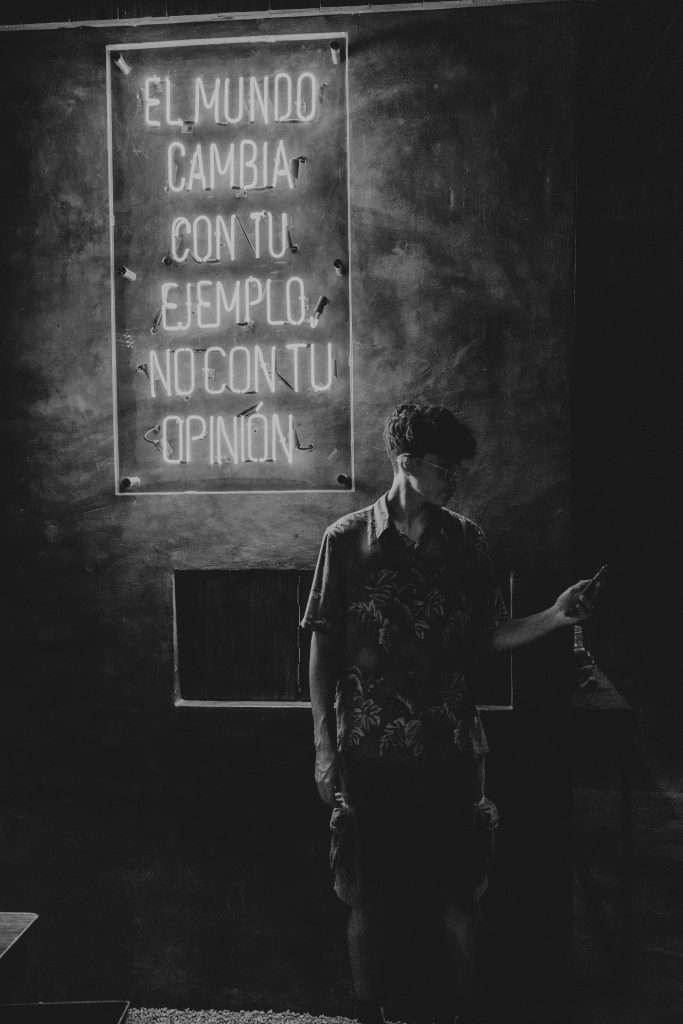
Being a good person is not a fixed feature, not one medal that hangs from the chest.
It is a scene. A interaction. A specific moment in which a story, a body, fear, power, and the person in front intersect.
When someone says “He's a good person.”, he often speaks as if describing an essence stable.
But goodness—as it is lived— appears or breaks down in context: with someone, in a place, under pressure, in a hurry, with incentives, with threat, with tiredness, with belonging or with loneliness.
Not because “the character does not exist”, but because the phrase “good person” sometimes functions as a narrative sedative: calms the complexity of the human.
Moral psychology has been pointing out something uncomfortable for years: many times feel first and it justify later.
Moral judgment is born quickly, automatically, and the explanation comes later to support it before others (Haidt).
And there's also an almost unavoidable bias: the type of person and it is underestimated situation.
It becomes a punctual conduct in a verdict on character, forgetting that the context It may be guiding more than one is willing to admit (Ross; Gilbert & Malone).
That's why one of the most frequent misconceptions is this: believing that “good person” is who avoid conflict.
But avoid conflict It is not synonymous with goodness.
Sometimes it is survival.
Sometimes it is rigid education (“don’t contradict”, “don’t bother”).
Sometimes it is low self-efficacy (“I don’t know how to sustain tension”).
Sometimes it's a identity built for not to lose love: “If I'm easy, I'll stay inside”.
The kindness may incline to soften or avoid confrontation, and not always in a healthy way: it can leave “"Good" on the outside and broken on the inside.
And here comes one adult truth: the assertiveness it's not assault.
Setting boundaries, maintaining friction, telling the truth without humiliating, can be precisely what prevents resentment, double morality, and passive violence.
The kindness that depends on shut up To avoid losing approval, it looks more like learned submission that to ethics.
The idea of the deserted island It is brilliant for what it reveals: much of Morality is social.
It "“Well”"regulates coexistence:" harm, justice, loyalty, authority, cooperation.
Moral norms become visible when others are present, and they also change due to culture and ideology. (Moral Foundations Theory).
The nuance is important: even alone can to care for or degrade, to protect or destroy the environment, to uphold or betray values.
But “being good person”"As a label, it has something of mirror: needs real or imagined witnesses.
There is always a “another” inside -a awareness, a inward gaze— that question who is being.
And if the world is so complex, why do we insist on dividing it into good and bad?
Because Labeling reduces uncertainty.
And because it protects from a Inconvenient truth: Anyone can do harm under certain conditions.
There are classic findings that don't age because they don't speak of monsters, but of humans.
In the study by Darley and Batson (1973), even seminary students were much less helpful when they went with hurry: he The pressure was crushing morale.
And Milgram (1963) showed how the obedience to authority can push ordinary people to do things terrible believing that “They just comply.”.
That doesn't absolve anyone. But it forces us to look at the architecture: sometimes Evil does not originate from demons, but of systems, routines, fear, rigid ideologies, and delegation of responsibility.
Arendt He named him with a disturbing expression: the banality of evil.
No there always is sadism; Sometimes there are career, obedience, and lack of critical thinking.
That's why, when it is said “the villains of the story”"It's worth clarifying: there's no need to assume." monstrosity to explain atrocities.
Just look at how context, ideology, fear, and obedience reorganize the moral compass.
The question is not just “who is bad?", but "what conditions make the damage reasonable?”.
Then there is the metaphor of the tribe, which is one of the most honest: in human groups, “Well”" usually means loyal, cooperative, useful to us.
Belong organizes perception, identity and preferential treatment towards our own (Social Identity Theory).
But then he appears edgeMorality is often partial.
There is parish altruism: care and sacrifice for oneself combined with indifference or hostility towards those from outside.
A "“tribe of good people”" could be Warm inside and cruel outside.
The tribal goodness It is real and human; the ethical challenge is to expand it without losing firmness, without converting to different in enemy.
And yet—and this is important— not everything is context.
If everything were about circumstances, nobody would be anything.
There is individual differences relevant, especially when morality is integrated into the identity.
Aquinas and Reed (2002) showed that when “to be moral” is central to self-concept, increases the probability of acting in coherence, even when costs.
But even here there are pitfalls: sometimes doing something good produces “moral license”, as if consciousness were given by paid and then something was allowed worse.
Morality is also fragile self-regulation, not one beeline.
So, what does it really mean to be a good person?
It means that one is not a statue. It is a practice.
It means that kindness is not always gentle: sometimes it's a limit.
Sometimes it's a "“no” that trembles, but it doesn't humiliate.
It means that when someone finds a wound, it is chosen not to convert it into weapon.
It means that it doesn't pass the forward pain to feel strong.
It means that it can be done fix When you fail—because you will fail—without hiding behind a label.
Being a good person isn't... declares.
HE maintains: low pressure, with cost, with awareness of group bias, with a moral identity integrated enough not to depend on applause.
Being a good person is a verb, a gerund.
And it's especially noticeable in the moments when it would be easiest to stop being that way.
References
- Aquino, K., & Reed, A. (2002). The self-importance of moral identity. Journal of Personality and Social Psychology, 83(6), 1423–1440. (PubMed)
- Arendt, H. (1963). Eichmann in Jerusalem: A Report on the Banality of Evil. (Wikipedia)
- Blanken, I., van de Ven, N., & Zeelenberg, M. (2015). A meta-analytic review of moral licensing. Personality and Social Psychology Bulletin, 41(4), 540–558. (PubMed)
- Choi, J.-K., & Bowles, S. (2007). The coevolution of parochial altruism and war. Science. (PubMed)
- Darley, J.M., & Batson, C.D. (1973). “From Jerusalem to Jericho”: A study of situational and dispositional variables in helping behavior. (faculty.washington.edu)
- Gilbert, D.T., & Malone, P.S. (1995). The correspondence bias. Psychological Bulletin, 117(1), 21–38. (DTG Sites)
- Graham, J., Haidt, J., & colleagues. (2013). Moral Foundations Theory: The pragmatic validity of moral pluralism. (bpb-us-e2.wpmucdn.com)
- Haidt, J. (2001). A social intuitionist approach to moral judgment. (PubMed)
- Milgram, S. (1963). Behavioral study of obedience. Journal of Abnormal and Social Psychology, 67, 371–378. (demenzemedicinagenerale.net)
- Ross, L. (1977). The intuitive psychologist and his shortcomings. (ScienceDirect)
- Tajfel, H., & Turner, J.C. (1979). An integrative theory of intergroup conflict. (alnap.cdn.ngo)